Garbage Disposal Air Switch vs. Wireless Switch
Which Is Right for Your Kitchen?
If you’re installing or replacing a garbage disposal, you don’t necessarily need a traditional wall switch. Two popular alternatives are pneumatic air switches and wireless switches.
Both keep the user-operated control separate from the disposal’s line-voltage connection, but they work very differently.
Air switches use a pneumatic pulse through tubing. Wireless switches use an electronic signal between a transmitter and receiver.
The right choice depends on how you want to install the switch, where you want the button located, whether you want batteries or wireless electronics, and whether you already have an available countertop opening.
Air Switch vs. Wireless Switch: Quick Comparison
| Feature | Air Switch | Wireless Switch |
|---|---|---|
| How it works | Pneumatic air pulse | Wireless electronic signal |
| Battery required | No | Depends on model |
| Wiring at button | No | No |
| Tubing required | Yes | No |
| Countertop hole | Usually | Often not |
| Wireless pairing | No | May be required |
| Radio interference | No | Possible |
| Button electronics | None | Yes |
| Kitchen island compatible | Yes | Yes |
| Permanent countertop installation | Yes | Depends on product |
| Replacement parts | Button/tubing/switch | Transmitter/receiver/battery |
| Range limitations | Tubing configuration | Wireless range |
| Best suited for | Permanent sink/counter control | Flexible button placement |
Which Is More Reliable?
An air switch relies on a physical pneumatic connection. Pressing the button compresses a small bellow, producing air pressure that travels through tubing and actuates the switch. There is no wireless connection to pair and no radio signal involved.
A wireless switch relies on successful electronic communication between a transmitter and receiver. Quality wireless systems can provide reliable operation, but performance depends on the particular technology, product quality and installation environment.
The key difference isn’t necessarily that one technology is universally more reliable. It’s that they have different potential failure points: air-switch issues are primarily mechanical or pneumatic, while wireless issues are primarily electronic and communication related.
How Are They Powered?
The garbage disposal requires electrical power regardless of which control method you choose. The difference is at the user control.
An air-switch button doesn’t need electricity. The physical movement of the button generates the pneumatic signal. A wireless transmitter requires a method of generating an electronic signal, and its power source depends on the particular product.
Do They Need Batteries?
An air-switch button does not require a battery. The user supplies the energy required to create the pneumatic signal simply by pressing the button.
Wireless switches vary. Some transmitters are battery powered, while other designs may use different methods. Check the manufacturer’s specifications rather than assuming every wireless disposal switch uses – or doesn’t use – a battery.
Which Is Easier to Install?
That depends heavily on the kitchen. An air switch typically requires a mounting location for the push button and pneumatic tubing between the button and control.
A wireless switch eliminates the pneumatic tube and may allow more flexibility in positioning the user control. This can be useful when avoiding a new countertop opening is a priority.
An air switch can be particularly straightforward when the sink already has an unused accessory opening suitable for the button. For new countertops, the air-button opening can also be planned during fabrication.
Visit our how to install a garbage disposal air switch for more information.
What About Range?
An air switch doesn’t communicate wirelessly, so radio range isn’t a consideration. Instead, installation is governed by the allowable pneumatic tubing configuration and the manufacturer’s specifications. Our standard air switch uses 8-ft of air tubing, but 100-ft distances are available. Contact us for custom options.
Wireless systems have a specified operating range. In an ordinary kitchen this may be sufficient, but actual performance can depend on the system and installation environment.
Which Provides Better Electrical Isolation?
An air switch provides a straightforward form of isolation at the user control: the push button contains no electrical circuit. It simply moves air, while electrical switching takes place at the control connected to the disposal’s electrical supply.
Wireless switches can also eliminate line-voltage wiring at the user-operated control. However, the transmitter itself is still an electronic device. For someone specifically seeking a non-electrical user-operated button, that distinction favors the pneumatic design.
What About Water Around the Sink?
A kitchen sink is naturally an environment where splashes and moisture occur. A pneumatic button is useful because the actuation point doesn’t require electricity.
However, an air-switch installation should not be described as completely waterproof unless the specific product carries an appropriate rating. Electrical components beneath the sink still require proper installation. Wireless products should similarly be evaluated according to the manufacturer’s environmental and water-resistance specifications.
Are Garbage Disposal Air Switches Safer?
An important difference between a pneumatic air switch and a traditional electrical switch is what is physically present at the user-operated button.
With a PresAir pneumatic air switch, the countertop button contains no electrical circuit. Pressing the button creates an air pulse that travels through tubing to the electrical switch located below the sink.
That makes pneumatic switching particularly useful around kitchen sinks and other locations where moisture may be present.
Which Is Easier to Replace?
An air-switch system typically consists of a button, tubing and electrical air switch. Depending on the system, individual components can potentially be serviced or replaced. Visit our online store for replacement parts.
A wireless system typically consists of a transmitter and receiver/controller. Whether one component can be replaced independently depends on compatibility and the manufacturer’s pairing system. For either technology, replacement-part availability is worth considering.
Which Requires More Maintenance?
Neither system should require extensive routine maintenance when properly installed.
An air switch has no battery at the button. Potential service issues are generally related to the button, pneumatic tubing or electrical control. Some wireless systems may eventually require transmitter battery replacement, and electronic components can eventually require replacement.
Which Costs More?
There isn’t a universal answer. Both categories contain inexpensive and premium products.
Instead of comparing purchase price alone, consider purchase price + installation + replacement parts + maintenance. A lower initial price doesn’t necessarily mean a lower lifetime cost.
Which Is Better for a Kitchen Island?
Both technologies can solve the lack-of-a-convenient-wall-switch problem found with many island sinks.
A wireless switch may make sense if avoiding a countertop penetration or pneumatic tubing is a priority. An air switch may make more sense if you want a permanent push button installed directly beside the sink, particularly if an appropriate sink accessory opening already exists or the countertop is being fabricated.
For a deeper look specifically at island installations, read our online article here.
Air Switch Pros
- No battery at the button
- No wireless pairing
- No radio signal
- No electrical circuit in the button
- Permanent countertop installation
- Excellent option for kitchen islands
- Simple pneumatic operating principle
- Individual components can be replaced
- Available in multiple finishes
Air Switch Considerations
- Requires pneumatic tubing
- Usually requires a countertop or sink opening
- Tubing needs to be routed beneath the sink
- Button location is less flexible than some wireless systems
Wireless Switch Pros
- No pneumatic tubing
- Flexible button placement
- May eliminate the need to drill a countertop
- Useful for retrofit installations
- Convenient where an existing sink opening isn’t available
Wireless Switch Considerations
- Transmitter may require batteries
- Wireless systems require electronic communication
- Pairing may be required
- Range depends on the specific product
- Signal performance can vary with the installation environment
- Replacement may require compatible transmitter/receiver components
Which Garbage Disposal Switch Is Right for You?
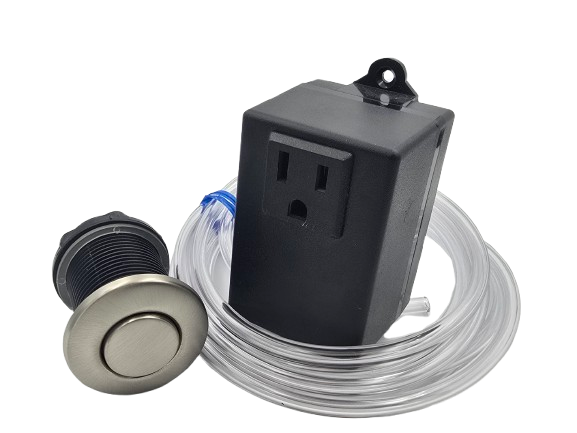
Choose an Air Switch If:
- You want a permanent countertop button.
- You don’t want a battery in the user control.
- You don’t want wireless communication.
- Your sink has an available accessory opening.
- You’re installing a new countertop and can plan the button location.
- You want a simple pneumatic control system.
Consider a Wireless Switch If:
- You want to avoid drilling a countertop.
- You don’t want to run pneumatic tubing.
- You need maximum flexibility in button placement.
- You’re retrofitting an existing kitchen.
- Your preferred location doesn’t have an appropriate opening.


